Series B startups are companies raising the third major round of venture financing, typically following seed and Series A. Series B funding usually ranges from $20 million to $60 million at a median pre-money valuation around $119 million, raised after a startup has proven product-market fit and needs capital to scale operations, expand teams, and enter new markets. Investors at this stage want evidence of repeatable growth, not just potential.
How Series B Funding Works
A startup raises Series B once it’s stopped asking “does this work?” and started asking “how fast can this grow?” That shift is the whole point of the round.
By Series B, the company already has paying customers, a product people use, and some proof the business model holds up. The money raised at this stage isn’t for building the first version of the product. It’s for scaling what already works: hiring across sales, engineering, and operations; expanding into new markets or customer segments; and building the infrastructure that early-stage teams usually skip.
The investors writing these checks are mostly growth-stage venture capital firms — many of the same names from Series A, joined by new firms that specialize in later-stage scaling rather than early bets. They’re not just buying into an idea anymore. They’re underwriting a growth trajectory, and they expect the numbers to back it up.
Series B vs. Seed vs. Series A vs. Series C
Each funding round serves a different purpose, and the differences are bigger than just the size of the check.
Seed funding pays for figuring out if there’s a real product to build. Series A pays for proving the business model works at a small scale. Series B pays for scaling what’s already proven. Series C — when it happens — pays for market dominance, acquisitions, or preparing for an IPO.
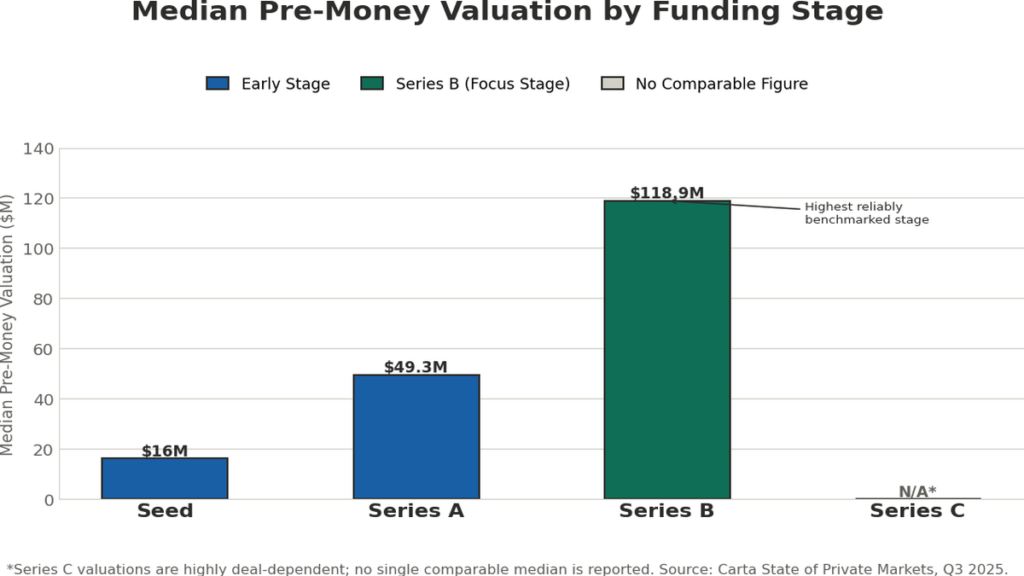
| Stage | Typical Round Size | Median Pre-Money Valuation | Typical Founder Dilution | What Investors Want |
| Seed | $2M–$5M | ~$16M | ~19.5% | A real product and early signs of demand |
| Series A | $2M–$20M | ~$49M | ~18% | Repeatable growth, $1M+ ARR is a common baseline |
| Series B | $20M–$60M | ~$119M | ~14% | Proven business model, clear path to scale |
| Series C | Larger, deal-dependent | Highly variable | Lower, deal-dependent | Market leadership, expansion capital, or exit prep |
Figures reflect recent Carta private-market benchmark data and vary meaningfully by sector and geography.
The jump from Series A to Series B is usually the biggest mental shift for founders. Series A investors will forgive a messy go-to-market plan if the product is strong. Series B investors generally won’t. They want to see the engine already running.
How Much Do Series B Rounds Raise? (2026 Data)
Series B rounds typically raise between $20 million and $60 million, with a median pre-money valuation around $119 million based on recent Carta private-market data covering U.S. startups.
Why Series B Startups Raise Such a Wide Range
That range is wide, and the gap is mostly explained by sector. AI startups currently raise larger Series B rounds at meaningfully higher valuations than non-AI companies at the same stage — a premium that’s shown up consistently from Series A onward, as reported by TechCrunch, which found capital increasingly concentrated in fewer, larger AI rounds even as overall deal counts decline. If you’re not building an AI product, it’s worth resisting the urge to benchmark your round against the loudest headlines. Most Series B companies aren’t raising at AI-inflated multiples, and that’s normal, not a red flag.
Round sizes also move with the broader market, and data from Statista tracks this variability in median deal size by funding series over time. Total Series B dollars deployed has fluctuated noticeably quarter to quarter in recent years, and deal volume — the actual number of Series B rounds closing — has trended down even as the median valuation for the rounds that do close has gone up. Translation: fewer companies are reaching Series B, but the ones that do are commanding higher prices. That’s a tougher bar to clear, not an easier one.
What Investors Look for Before Writing a Series B Check
Series B investors are evaluating a business, not a vision. They want growth rate, gross margin, annual recurring revenue, net revenue retention, customer acquisition cost, and lifetime value — and they want those numbers trending the right direction for at least a few consecutive quarters, not just one good month.
This is also where the timeline matters more than founders expect. Recent data shows the median company raising Series B waited roughly 2.8 years after their Series A round — the longest gap on record. That’s not a sign something went wrong. It reflects a market where investors want more proof before writing a bigger check, and companies are taking longer to generate it.
In practice, most companies spend that gap doing unglamorous work: tightening unit economics, building out a repeatable sales process, and proving the first wave of customers wasn’t a fluke. Series B isn’t usually won with a great pitch. It’s won with eighteen months of boring, consistent numbers.
How Much Equity Do Founders Give Up by Series B?
Founders typically own a shrinking share of their company at each round, and Series B accelerates that decline more than most founders expect going in.
Recent benchmark data shows founding teams holding around 56% ownership after a priced seed round, dropping to roughly 36% by Series A, and down to about 23% by Series B. Each round dilutes ownership by single or low double digits, but the compounding effect across three rounds is significant — most founders have given up more than half their company before Series B even closes.
That’s not necessarily a bad trade. A smaller slice of a company that’s actually scaling is usually worth more than a larger slice of one that never gets there. But it does mean control and governance conversations get more serious at this stage. Boards add outside members. Decisions that used to be a founder’s call alone start requiring sign-off.
What a Series B Startup Looks Like
A typical Series B company today is leaner than you’d expect, and leaner than Series B companies were just a few years ago.
Recent data puts the average Series B team at around 48 employees — down from roughly 72 in 2022. That’s a real shift, not noise, and it tracks with how AI tooling has changed what a small team can ship without adding headcount. Companies are reaching the same growth milestones with meaningfully fewer people than they needed three years ago.
In practice, that means a Series B company isn’t necessarily the sprawling, multi-department organization the term might suggest. It often still feels closer to a startup than a scale-up: a focused team, a handful of functional leads, and a product that’s working well enough to justify the next $30 million or $40 million bet.
Some of today’s largest companies passed through exactly this stage on their way up. Revolut, Monzo, and Checkout.com — now major names in global fintech — all raised Series B rounds years before reaching their current scale. At the time, each looked like any other Series B company: proven traction, a lean team, and a much smaller valuation than the one they’d eventually command.
The Bottom Line
Series B funding marks the point where a startup has to perform, not just promise. The capital is bigger, the scrutiny is sharper, and the equity cost is real. If you’re evaluating a Series B company — as an employee, partner, or observer — the headline valuation matters less than what’s actually happening underneath it: growth that’s holding up, quarter after quarter.
FAQ
What comes after Series B?
Most companies move to Series C, used for market expansion, acquisitions, or preparing for an IPO. Some companies skip straight to growth equity or go public without a formal Series C round.
Is Series B good or bad for a startup?
Neither inherently. It signals validated traction and investor confidence, but it also means more dilution, more oversight, and higher growth expectations to justify the valuation.
How long does it take to raise a Series B round?
Recent data shows a median gap of about 2.8 years after Series A, though this varies widely by sector, growth rate, and market conditions at the time of the raise.
Do all startups need a Series B round?
No. Many profitable or bootstrapped companies skip it entirely, and some startups raise only seed or Series A funding before reaching sustainable, self-funded growth.
What’s the difference between Series B and Series C?
Series B funds proving a business model can scale. Series C typically funds expanding that proven model further — new markets, acquisitions, or positioning for an eventual exit.