Dallas startups raised a record $1.6 billion in venture capital in 2025, making DFW the #4 startup ecosystem in the United States. The city’s leading sectors are healthcare tech, fintech, AI, and enterprise SaaS. Unicorns like Island ($5B valuation) and o9 Solutions anchor the scene, backed by investors including Perot Jain and Tech Wildcatters.
The Dallas Startups Ecosystem at a Glance
Dallas is no longer a footnote in the American startup conversation. It’s a headline.
The DFW metroplex now hosts over 2,000 active startups, more than 120,000 tech workers, and a venture capital market that has grown 34% year over year. For a city that was described as “something of a venture desert” as recently as 2018, that trajectory is striking.
Key Numbers That Define DFW’s Momentum
| Metric | Figure |
| Active startups | 2,000+ |
| Total startup funding (cumulative) | $3B+ |
| VC raised in 2025 | $1.6 billion |
| YoY VC growth rate | 34% |
| Unicorns | 6–8 |
| Tech workers | 120,000+ |
| US ecosystem ranking | #4 |
| Global ecosystem ranking | #27–28 |
| Accelerators and incubators | 31 |
From “Venture Desert” to $2 Billion Target
Aaron Pierce, chair of the annual Venture Dallas conference and a partner at Perot Jain, described the region’s early days bluntly: in 2018, the first Venture Dallas summit drew 200 people to what he called a venture desert. The 2025 edition sold out for the fourth consecutive year and drew a record 140 startup nominations for its annual awards.
The funding arc tells the same story. Across 2025, Dallas startups raised capital in an accelerating pattern:
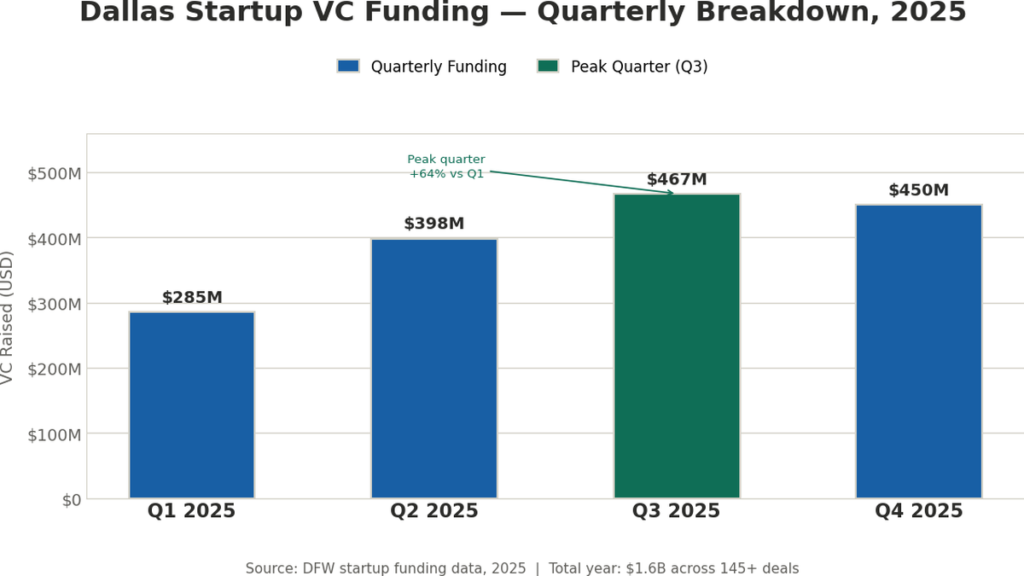
| Quarter | VC Raised |
| Q1 2025 | $285 million |
| Q2 2025 | $398 million |
| Q3 2025 | $467 million |
| Q4 2025 | $450 million |
| Full Year | $1.6 billion |
That Q3 peak — followed by a Q4 that held near the same level rather than dropping off — signals sustained investor conviction rather than a single headline deal skewing the numbers. Dallas companies are expected to cross $2 billion in annual VC raises in 2026, four times the total from just three years earlier.
Top Dallas Startups to Watch in 2026
The best way to understand an ecosystem is to look at the companies it produces. Dallas has a mix worth paying attention to: established unicorns with global reach, Venture Dallas award winners in early hypergrowth, and recently funded seed-stage companies building in new categories.
The Unicorns Leading Dallas Startups Forward
Island is the city’s highest-profile recent breakout. The enterprise browser company has raised $810 million and reached a $5 billion valuation, as reported by TechCrunch, making it one of the most valuable cybersecurity startups in the country. Island’s product sits at an unusual intersection: it gives IT teams control over what employees can do inside a browser, which turns out to matter enormously for enterprises running sensitive workloads.
o9 Solutions provides integrated business planning software to Fortune 500 companies. It’s a quiet but substantial business — the kind of enterprise SaaS company that Dallas’s corporate-heavy environment produces naturally.
LTK (formerly LikeToKnowIt) is a creator commerce platform that connects lifestyle influencers with over 5,000 global retailers. Built in Dallas in 2011, it’s one of the cleaner examples of the city producing a consumer-tech success story, not just B2B.
ShiftKey is a healthcare staffing marketplace that matches credentialed healthcare workers with facilities facing staff shortages. Healthcare staffing was already a large and broken market before the pandemic amplified every flaw in it. ShiftKey’s platform addresses both the scheduling problem and the credential verification problem in one product.
High-Growth Companies to Watch Right Now
At the 2025 Venture Dallas conference — held at the George W. Bush Institute and Presidential Library, with a record 140 nominations — three companies claimed Startup of the Year awards across different stages:
- Stablecore (Seed winner): digital asset infrastructure
- Worlds (Series A winner): physical AI platform
- BILT (Series B+ winner): 3D interactive instructions for product assembly and installation
Other companies worth tracking: Colossal Biosciences, the de-extinction biotech firm using CRISPR technology to restore extinct species, has become one of Dallas’s most-watched science-driven startups. HighLevel is a bootstrapped-to-VC marketing SaaS platform built for agencies. DataBank has raised the most capital of any Dallas-area company ($7.7 billion), though its private-equity-backed data infrastructure model makes it a different kind of animal than a traditional venture-backed startup.
On the seed and early-growth end, Lantern closed a $30 million round in early 2026 (virtual specialty care), and 4MINDS raised a $5.4 million AI seed round the same year.
Top Dallas Startups at a Glance
| Company | Sector | Stage | Total Raised | Notable Fact |
| Island | Cybersecurity | Late-stage | $810M | $5B valuation; enterprise browser product |
| o9 Solutions | Enterprise SaaS | Late-stage | Unicorn | Integrated business planning for Fortune 500s |
| LTK | Creator Commerce | Late-stage | Unicorn | 5,000+ global retail partners |
| ShiftKey | HealthTech | Growth | Unicorn | Healthcare staffing marketplace |
| Colossal Biosciences | Biotech | Series B | $225M+ | First CRISPR de-extinction company |
| HighLevel | Marketing SaaS | Growth | Bootstrapped → VC | Agency-focused CRM platform |
| Worlds | Physical AI | Series A | Undisclosed | 2025 Venture Dallas Series A winner |
| BILT | Instruction Tech | Series B+ | Undisclosed | 2025 Venture Dallas Series B+ winner |
| DataBank | Data Infrastructure | Private Equity | $7.7B | Largest capital raised of any DFW tech company |
| Lantern | Virtual Healthcare | Growth | $30M (2026) | Specialty care navigation platform |
Dallas’s Strongest Startup Sectors
Dallas doesn’t have one dominant sector. It has four — and a couple of underrated ones that most startup guides ignore entirely.
Healthcare Tech — Dallas’s Biggest Funding Magnet
Healthcare technology attracted $448 million in Dallas in 2025, representing 28% of all startup funding in the city. That’s not accidental. Dallas sits adjacent to one of the densest medical districts in the country: the Southwestern Medical District anchors the city’s health-science ecosystem, and Pegasus Park — a 26-acre biotech and life sciences campus near the Dallas Design District — has become a physical magnet for healthcare founders who want proximity to researchers, clinicians, and corporate health buyers.
Health Wildcatters, the city’s dedicated healthcare accelerator, has graduated dozens of companies and provides seed funding of $30,000 to $380,000 in exchange for 8% equity. It offers what most general-purpose accelerators can’t: introductions to payers, providers, and health system procurement teams.
Notable companies in this sector: ShiftKey, Lantern, VenoVision (AI-driven vascular imaging), and Colossal Biosciences on the biotech edge.
Fintech — Built on a Financial Services Legacy
Fintech captured 22% of Dallas’s 2025 funding. Dallas has been a financial services hub since the 1980s, and that corporate history means there’s local institutional knowledge, regulatory familiarity, and enterprise customer access that fintech founders in newer cities have to manufacture from scratch. Companies like Bestow (insurance tech), Stake (investing platform), and Pari (consumer finance) reflect both the breadth of the sector and its increasingly consumer-facing direction.
AI and Enterprise SaaS — The Growth Frontier
AI and machine learning startups took 18% of 2025 funding, and the trajectory suggests that share will grow. Island’s enterprise browser is fundamentally an AI-governance product. Worlds is building physical AI systems. o9 Solutions uses AI as a core engine in its planning platform.
The advantage Dallas has here that pure-tech cities don’t is direct access to enterprise buyers. A Dallas-based AI startup doesn’t have to fly to meet its first Fortune 500 customer — in many cases, that customer is headquartered down the road.
Energy Tech and Logistics — The Underrated Sectors
Energy tech claimed 12% of 2025 funding and often gets overlooked in startup narratives that default to software. Dallas is the corporate home of major energy companies and sits in a state that leads the US in renewable energy generation. That creates real deal flow for energy software, grid optimization, and cleantech startups that can access both legacy energy infrastructure and an expanding renewables sector.
Logistics and supply-chain tech benefit similarly from Dallas’s position as a distribution hub for the center of the country — multiple major carriers, intermodal freight networks, and a thriving industrial real estate market give logistics startups real operational partners to build with.
The Fortune 500 Moat — Why Dallas Is Built for B2B Startups
This is the angle most startup guides don’t mention, and it may be the most important structural fact about the Dallas ecosystem.
The Corporate Customer Advantage
Dallas and its suburbs are home to a remarkable concentration of Fortune 500 headquarters: AT&T, American Airlines, Toyota North America, and Caterpillar (which relocated its HQ to Irving in 2022) are among the major corporate anchors, and according to Fortune, Dallas alone is home to 11 Fortune 500 companies — more than any other Texas city.
For an enterprise B2B startup, this creates a structural advantage that coastal cities can’t replicate through startup density alone. It means:
- Pilot customers within 30 minutes of your office
- Procurement relationships that don’t require cold outreach to a distant headquarters
- A talent pool of senior operators who’ve spent careers inside large organizations and understand what enterprise buyers actually need
- Corporate venture arms and strategic partnership budgets that represent non-dilutive capital sources
Founders in Dallas regularly cite the ability to run enterprise pilots with local corporations as a meaningful accelerant in their early traction — something investors from outside Texas consistently find surprising.
How Corporate Giants Incubate Startups
AT&T has operated incubator and innovation programs in the Dallas area for years, and several of its technology initiatives have spun out or inspired independent ventures. Corporate venture arms at large Dallas-HQ’d companies provide not just capital but integration pathways — a startup that gets adopted inside American Airlines or Toyota as a vendor has a very different sales story than one still searching for its first reference customer.
This dynamic makes Dallas particularly well-suited for startups in regulated or complex industries: healthtech, insurtech, logistics software, and enterprise security. These are categories where a credible enterprise pilot matters more than viral consumer growth, and where Dallas’s corporate density is a genuine moat.
Dallas vs. Austin — Which Texas Startup City Is Right for You?
The short answer: they’re not competitors. They’re different ecosystems serving different founder profiles. But if you’re deciding where to plant your startup, the differences matter.
Dallas leads in healthcare tech, fintech, and enterprise SaaS — categories shaped by its corporate-heavy environment and regulated-industry expertise. Austin leads in consumer internet, developer tools, and gaming, shaped by its university culture and higher concentration of software engineers with consumer-product backgrounds.
The cost differential is real. Office space and cost of living in Dallas run roughly 15–20% cheaper than Austin, and the gap has widened as Austin’s growth has driven rents significantly higher. Crunchbase data puts the Dallas median pre-money Series A valuation at $18 million, versus $25 million in San Francisco and roughly $22 million in New York. That gap represents an opportunity for investors to access strong companies at more attractive entry points.
Dallas vs. Austin: Side-by-Side
| Factor | Dallas | Austin |
| 2025 VC raised | $1.6B | ~$2.8B (est.) |
| Strongest sectors | Healthcare, Fintech, Enterprise SaaS | Consumer internet, Gaming, Deep tech |
| Cost vs. each other | ~15–20% cheaper | ~15–20% more expensive |
| Series A median valuation | $18M | Closer to national average |
| Fortune 500 HQ density | High (AT&T, Toyota, AA, Caterpillar) | Lower |
| Top local VC | Perot Jain | S3 Ventures, Capital Factory |
| Top accelerator | Tech Wildcatters, Health Wildcatters | Capital Factory (HQ) |
| Best fit for | Enterprise B2B, regulated industries | Consumer apps, developer tools |
| Key sub-hubs | Plano, Frisco, Richardson, Irving | Round Rock, Cedar Park |
Many experienced Texas founders maintain a footprint in both cities. Austin for recruiting software engineers; Dallas for closing enterprise deals and accessing corporate buyers. It’s not either/or.
Funding Your Dallas Startup — VCs, Accelerators, and Incubators
Dallas has enough investor infrastructure now that a founder can raise from pre-seed through Series B without leaving the state. The gaps still exist at growth stage, where coastal firms tend to lead rounds, but the early-stage picture has materially improved.
Key Venture Capital Firms in Dallas
Perot Jain is the anchor of the ecosystem. Founded by Ross Perot Jr. and Anurag Jain, it positions itself as “patient capital” — a firm that takes a hands-on, long-term approach to company building. Perot Jain invests at seed and early stage across technology-enabled businesses, and its founding partners bring operational experience in healthcare, transportation, and infrastructure that makes them particularly well-connected for B2B founders in those sectors.
Tech Wildcatters is the city’s oldest and best-known mentorship-driven accelerator. Founded in 2009, it has graduated over 92 companies and invests across B2B and B2C from pre-seed through early venture rounds.
S3 Ventures and Silverton Partners are Texas-based multi-stage firms that actively write Dallas checks. RevTech Ventures focuses on retail and commerce tech. Dallas Venture Capital takes a broader technology mandate.
For founders looking beyond local capital, Capital Factory — headquartered in Austin but with an active Dallas presence — is considered the most connected early-stage network in Texas. Revolution’s Rise of the Rest Seed Fund also actively targets Dallas as part of its mission to back companies outside traditional coastal hubs.
Dallas VC and Accelerator Landscape
| Firm / Program | Type | Stage Focus | Sector Focus | Notes |
| Perot Jain | VC | Seed / Early | Tech-enabled, broad | Founded by Ross Perot Jr. & Anurag Jain; “patient capital” |
| Tech Wildcatters | Accelerator + VC | Pre-seed / Seed | B2B, B2C | Mentorship-driven; 92+ graduates since 2009 |
| Health Wildcatters | Accelerator | Seed | Healthcare only | $30K–$380K funding; 8% equity; payer/provider access |
| S3 Ventures | VC | Early / Growth | SaaS, enterprise | Texas-focused multi-stage |
| RevTech Ventures | VC | Seed / Early | Retail tech, B2B commerce | Niche retail + supply chain focus |
| Capital Factory Dallas | Accelerator + VC | Pre-seed / Seed | Broad tech | Most active early-stage investor in Texas |
| Dallas Venture Capital | VC | Early / Growth | Broad technology | Dallas-HQ’d generalist fund |
| MassChallenge Texas | Accelerator | Pre-seed | Broad | Equity-free; North Texas cohort |
| Deep Space Ventures | VC | Early | Sports tech, B2B software | Dallas-based niche fund |
Accelerators and Incubators Worth Knowing
UT Dallas Institute for Innovation and Entrepreneurship provides university-linked incubation valuable for research-heavy or deep-tech founders who want access to academic IP and technical co-founders. Pegasus Park functions less as a traditional accelerator and more as a physical ecosystem — its 26 acres near the Southwestern Medical District give biotech and life sciences founders proximity to clinical researchers, health system partners, and wet lab infrastructure that’s genuinely hard to find outside major biotech hubs. Code Launch serves seed-stage tech startups with a tighter focus on mentorship and early development resources.
The Practical Advantage — Cost, Talent, and Quality of Life
Runway is oxygen for startups. Dallas extends it.
The city’s cost of living index sits at roughly 101 — essentially flat with the national average — making it one of the most affordable major business hubs in the country. The average one-bedroom apartment runs around $1,300 per month. Compare that to San Francisco or New York, where the same dollar buys meaningfully less, and the arithmetic of early-stage company building shifts in your favor.
Texas has no state income tax. For founders taking a salary and for senior engineers comparing offers, that difference is real compensation — often equivalent to a 5–7% pay increase compared to equivalent roles in California, without requiring a higher nominal salary.
The talent picture has improved substantially. Dallas has over 120,000 tech workers, with the University of Texas at Dallas and SMU both producing technical graduates. The DFW metroplex’s sub-hubs each have their own character: Richardson and Plano form the historic Telecom Corridor, home to legacy tech infrastructure companies and a deep pool of enterprise software talent. Frisco has attracted multiple corporate HQ relocations and a growing startup office presence. Irving sits at the crossroads of the metroplex’s transportation and logistics networks.
One practical note for founders whose investor base is national: Dallas-Fort Worth International Airport is one of the most connected hubs in the country, with direct routes to every major VC market — which matters when your enterprise customers and lead investors are in different cities.
Conclusion
Dallas startups have moved from the margins to the mainstream. The funding is real, the unicorns are operating at scale, and the corporate infrastructure gives enterprise founders an edge that coastal ecosystems simply can’t replicate. Whether you’re investing, hiring, or building, DFW’s startup ecosystem rewards those who engage with it seriously.
Dallas Startups FAQ
Are Dallas startups worth investing in?
Yes. Dallas startups raised $1.6 billion in 2025, with Series A median valuations at $18M — roughly 28% below San Francisco levels. Investors get access to strong enterprise B2B and healthtech companies at more attractive entry points, backed by Fortune 500 pilot customers and an active local VC community.
What is the best sector for startups in Dallas?
Healthcare tech led 2025 funding at $448 million (28% of total), followed by fintech (22%) and AI/ML (18%). Enterprise SaaS broadly benefits from Fortune 500 density. Founders in regulated industries — health, insurance, logistics — consistently find Dallas’s corporate customer access a meaningful advantage.
How does Dallas compare to San Francisco for startup valuations?
Dallas Series A companies carried a median pre-money valuation of $18 million in 2025, versus roughly $25 million in San Francisco. That gap means investors access comparable-quality companies at lower entry points, and founders give up less ownership per dollar raised.
What are the top accelerators for Dallas startups?
Tech Wildcatters (B2B/B2C, pre-seed to seed), Health Wildcatters (healthcare, seed stage), Capital Factory Dallas (broad tech, most active statewide network), and MassChallenge Texas (equity-free, early stage) are the primary options. Pegasus Park serves biotech and life sciences founders specifically.
How much venture capital did Dallas startups raise in 2025?
Dallas startups raised $1.6 billion across 145+ deals in 2025 — a 34% year-over-year increase. Funding peaked at $467 million in Q3. Dallas companies are projected to cross $2 billion in annual VC raises in 2026.