A biotech startup is an early-stage company using biological systems or their derivatives to develop products — typically in therapeutics, diagnostics, agriculture, or industrial processes. Starting one requires choosing a sub-sector, building a milestone-driven funding strategy, and engaging regulatory planning from day one. Most biotech startups take 7–12 years and significant capital to reach market.
What Is a Biotech Startup — And How It Differs From Every Other Startup
Biotech startups are not tech startups with lab coats. The business model, risk profile, capital structure, and timeline operate on fundamentally different logic — and founders who treat them as similar discover that expensively.
Why the Biotech Startup Model Is Structurally Unique
A biotech startup applies biological science to create commercial value: a novel cancer drug, engineered bacteria producing sustainable materials, a CRISPR-based crop, or a new diagnostic test. What these share: long development cycles, heavy regulatory oversight, and dependence on scientific milestones — not user growth metrics — to drive valuation.
Biotech vs Tech Startup — A Structural Comparison
| Dimension | Biotech Startup | Tech Startup |
| Time to market | 7–12 years (therapeutics); 2–4 years (diagnostics) | 6 months–3 years |
| Capital required | $10M–$500M+ depending on sub-sector | $500K–$50M typical |
| Trial failure rate | 90%+ of drug candidates that enter trials fail | No equivalent regulatory gate |
| Regulatory burden | FDA/EMA mandatory for therapeutics | Light to none for most SaaS |
| MVP concept | Proof-of-concept data; IND filing; Phase I trial | Functional product with user traction |
| Primary exit path | Pharma acquisition; IPO | Big tech acquisition; IPO |
| Primary investor type | Life science VCs, pharma corporate VC, NIH/SBIR | General VC, angels, growth equity |
This table is a calibration tool, not a deterrent. Founders who understand these differences plan accordingly — those who don’t discover them expensively.
Choose Your Sub-Sector Before You Choose Anything Else
The most consequential early decision in any biotech startup is not your hiring plan or pitch deck. It is your sub-sector. Each has its own regulatory logic, timeline, funding environment, and failure modes.
Therapeutics, Diagnostics, Agbio, and Industrial Biotech Compared
Therapeutics (Drug Development) — Highest risk, highest reward. FDA approval via phased clinical trials. Timelines run 10–15 years for novel mechanisms. Most biotech VC is concentrated here.
Diagnostics and Medical Devices — Often follow 510(k) clearance or De Novo classification, substantially faster than a full NDA. A well-designed diagnostic startup can reach commercialization in three to five years with a fraction of the capital a drug program requires.
Agricultural Biotechnology — USDA and EPA oversight rather than FDA for most applications. Funding concentrated among specialized agri-VCs and corporate strategics. Competitive moats live in IP and trait licensing.
Industrial and Synthetic Biology — Lower regulatory burden than therapeutics, but manufacturing scale-up is the defining challenge. Moving from lab yields to commercial production economics is notoriously difficult.
| Sub-Sector | Regulatory Pathway | Typical Timeline | Startup Cost Range | Representative Companies |
| Therapeutics | FDA IND → Phase I/II/III → NDA/BLA | 10–15 years | $20M–$500M+ | Moderna, BioNTech (origins) |
| Diagnostics | FDA 510(k) / De Novo / PMA | 3–6 years | $2M–$30M | Guardant Health (origins) |
| Agricultural Biotech | USDA/EPA; FIFRA for some | 5–10 years | $5M–$100M | Indigo Agriculture |
| Industrial/Synbio | EPA for GMO release; lighter otherwise | 3–8 years | $3M–$50M | Ginkgo Bioworks |
The sub-sector you know best — through research, clinical work, or prior employment — is where your network, scientific judgment, and regulatory awareness compound fastest. That advantage outweighs any theoretical market size calculation.
Build the Right Team — Scientists Alone Won’t Get You There
Most biotech startup founders are scientists first. That is a strength in the lab and a liability in every other function. The companies that survive their first five years almost always have scientific depth and operational, regulatory, and commercial coverage in the founding team.
The Four Roles Every Biotech Startup Needs Early
Chief Scientific Officer / Scientific Co-Founder — Owns the core hypothesis, experimental design, and data integrity. If this is you, ensure the other three roles are filled before you start spending.
Regulatory and clinical development lead — Has filed an IND, managed FDA interactions, or led a 510(k) submission. One wrong step delays a program by months and resets investor confidence.
Business development / commercial lead — Understands pharma deal structures, builds compelling pitches for strategic partners, and manages investor relationships. Required long before a product reaches shelves.
Finance / operations lead — Burn rate management in biotech is existential. Runway directly determines which clinical milestones you reach, and milestones determine your next round’s valuation.
How to Structure Equity for Scientists and Advisors
Scientific advisors typically receive 0.1%–0.5% equity in option grants vesting over two to three years, in exchange for ongoing specific contributions — lab access, regulatory introductions, or monthly scientific review. More than that for advisor-level engagement signals an unclear relationship.
Co-founder equity differs. Where technology originated in one founder’s lab, common structures include a university IP-licensing arrangement plus asymmetric equity reflecting different risk contributions.
The Virtual Biotech Model — How Modern Startups Stay Lean
The virtual biotech startup has correctly identified which activities require capital investment and which can be contracted out. It is not a company that lacks ambition.
What a Virtual Biotech Startup Actually Looks Like
A virtual biotech has a small founding team — typically three to eight people — that owns the scientific vision, regulatory strategy, and capital allocation. All laboratory work is performed by CROs. Manufacturing is handled by CMOs. The company holds the IP, makes strategic calls, and writes the checks.
This model can allow a company to advance from concept to IND filing for $3M–$8M in some therapeutic areas — work that would require $15M–$30M if the company owned lab space and a full headcount.
When the Virtual Model Breaks Down
Virtual biotech works well when the science is well-characterized and experimental work is execution-dependent. It works less well when your scientific edge is a novel platform requiring continuous iteration and tacit knowledge — a proprietary cell line, a custom synthesis route, or a genuinely novel manufacturing process. Institutional knowledge built in-house is difficult to replicate across CRO relationships.
Regulatory Strategy Is a Fundraising Strategy
Most biotech startup founders treat regulatory planning as compliance work that happens after the science is done. That framing is costly. FDA designations and interaction milestones directly affect valuation and fundraising ability.
The FDA Pathway From IND to Approval — A Founder’s Map
Preclinical phase — Lab and animal studies establishing safety and preliminary efficacy. Typically 1–3 years.
IND (Investigational New Drug) application — Filed before any human dosing. The FDA has 30 days to review and can place a clinical hold for safety concerns. IND acceptance is a recognized valuation milestone in early-stage financing.
Phase I — First-in-human studies, focused on safety and dosing (20–100 patients).
Phase II — Preliminary efficacy and continued safety (50–300 patients). Failure rates for novel mechanisms run close to 70%.
Phase III — Pivotal trials in large populations (300–3,000+). Extremely capital-intensive.
NDA / BLA submission — Full regulatory package submitted for approval. Standard review runs 6–12 months.
Regulatory Designations That Change Your Biotech Startup’s Valuation
Orphan Drug Designation (ODD) — For conditions affecting fewer than 200,000 US patients. Grants seven years of market exclusivity plus a 25% tax credit on qualified clinical trial expenses.
Breakthrough Therapy Designation (BTD) — Requires preliminary clinical evidence of substantial improvement over existing therapy. Life science VCs treat this as a 2–3x valuation premium signal at Series A — it de-risks the regulatory pathway in a way preclinical data alone cannot.
Fast Track Designation — Lower bar than BTD; available for drugs addressing serious conditions with unmet need. Grants more frequent FDA meetings and rolling review.
Milestone-to-Capital: How Investors Tie Funding to Regulatory Checkpoints
Sophisticated investors increasingly structure early-stage term sheets with capital tranches tied to regulatory milestones: one tranche at signing, a second upon IND acceptance, a third upon first patient dosed. Miss an IND filing date by eight months due to unexpected toxicology results and you are behind on capital as well as science. Build contingency into every regulatory timeline.
How to Fund a Biotech Startup in 2026
Raising money for a biotech startup in 2026 is harder at seed and Series A than it was two years ago. The data are specific.
What Each Funding Stage Actually Looks Like in a Biotech Startup
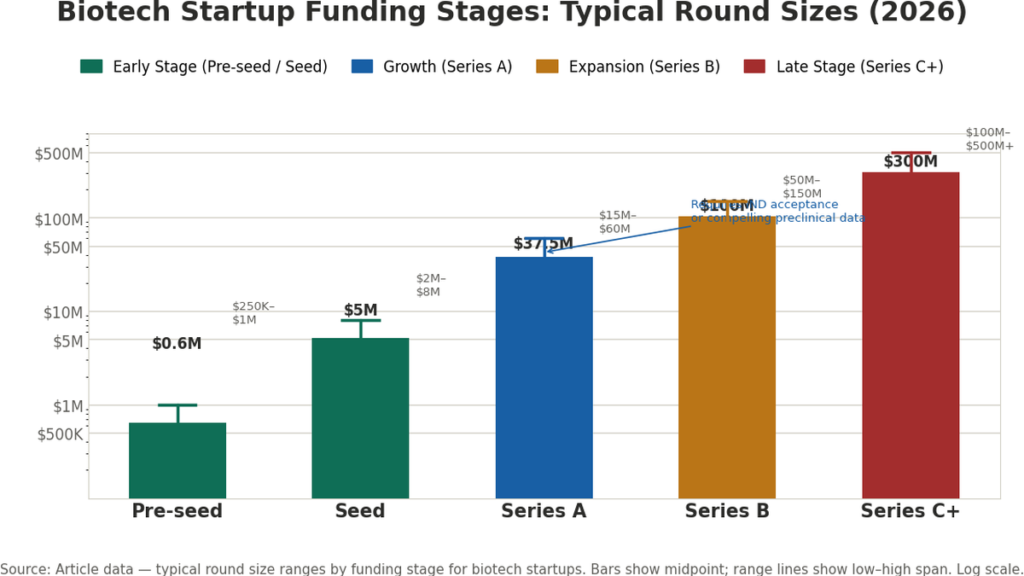
| Stage | Typical Round Size | Primary Use of Funds | Who Invests | What You Need to Show |
| Pre-seed | $250K–$1M | IP licensing, early proof-of-concept | Founders, angels | Credible scientific hypothesis and team |
| Seed | $2M–$8M | IND-enabling studies, CRO partnerships | Angel groups, life science seed funds, SBIR/STTR | Early preclinical data; regulatory-pathway thesis |
| Series A | $15M–$60M | IND filing, Phase I initiation | Life science VCs, corporate VCs | IND acceptance or compelling preclinical data |
| Series B | $50M–$150M | Phase II trials, manufacturing scale-up | Lead VC syndicate, crossover investors | Phase I safety and preliminary efficacy data |
| Series C+ | $100M–$500M+ | Pivotal trials, commercial readiness | Crossover funds, public market investors | Phase II efficacy data; clear path to Phase III |
The 2026 Funding Reality — What the Data Actually Shows
Early-stage biotech funding has slipped after a brief recovery. J.P. Morgan tracked 50 seed and Series A investments worth $2.3 billion in Q1 2026 — down from 60 deals worth $3.7 billion in Q1 2025. As reported by CNBC, strategic buyers are aggressively deploying capital in 2026, but that activity is concentrated in later-stage acquisitions, not early-stage formation rounds. Of 24 disclosed deals over the June 2025–May 2026 window, 16 were follow-on financings — investors reinforcing existing platforms rather than broadly seeding new companies.
The practical implication: founders raising seed rounds in 2026 face the bar that used to define Series A. IND-enabling data or a fully formed regulatory strategy is increasingly expected before a first institutional check.
Non-Dilutive Funding — SBIR, STTR, and Government Grants
The NIH’s SBIR and STTR programs provide Phase I grants up to $300,000 and Phase II grants up to $2 million or more, with no equity required. An SBIR award both funds IND-enabling work and signals scientific credibility to future investors. Plan for a six-to-nine-month application-to-award cycle.
How AI-Biotech Positioning Affects Your Valuation
AI-assisted biotech companies raised at a median valuation premium of approximately 35% over comparable non-AI peers at Seed and Series A in 2024–2025, per PitchBook’s life sciences report. If your platform genuinely uses machine learning to accelerate target identification or optimize trial design, make that architecture central to your pitch. Investors with scientific diligence capabilities will distinguish real AI integration from surface-level labeling quickly.
Why Biotech Startups Fail — and the Patterns That Predict It
Failure in biotech is common, expensive, and often foreseeable in retrospect.
The Numbers Every Biotech Startup Founder Should Know
According to data from Statista, drug development costs have risen from approximately $1 billion per drug in the 1990s to around $2.6 billion today — and that figure accounts for all the failed attempts along the way. Over 90% of pharmaceuticals that enter FDA clinical trials fail. At the company level, roughly 60% of biotech startups fail within five years and 90% eventually. Phase II failure rates for novel mechanisms run close to 70%.
These are calibration numbers. A founder who internalizes them builds a portfolio hypothesis — staged capital, early kill decisions — rather than betting the entire company on a single compound.
The Five Most Common Failure Modes
1. Running out of capital before a derisking milestone. Biotech timelines slip. Build 12–18 months of contingency into your financial model.
2. Scientific hypothesis that was never truly derisked. Third-party scientific review before committing to a full program is an investment, not a delay.
3. Team gaps in regulatory and commercial expertise. Missing pre-IND meeting opportunities and failing to pursue valuable designations are direct consequences.
4. No clear market need. Rare disease programs often avoid this trap. Broad-market programs can spend a decade reaching approval only to find the commercial forecast was wrong.
5. Sub-sector mismatch with the founding team’s capabilities. Alignment between founding team experience and program choice predicts survival better than most early variables.
The Biotech Startup Ecosystem — Where to Build and Who to Know
Geography matters in biotech more than most founders expect. Lab space, scientific talent, regulatory expertise, and VC relationships remain concentrated in a few clusters.
The Three Major US Biotech Hubs
Greater Boston / Cambridge — Highest density of biotech companies globally, anchored by MIT and Harvard Medical School spinout activity. Talent density and investor access are unmatched; real estate and hiring costs reflect it.
San Francisco Bay Area — Particular strength in platform biology, synthetic biology, and diagnostics. South San Francisco’s deep operator networks grew from decades of Genentech’s regional influence.
San Diego — Built around Scripps Research, UC San Diego, and the Salk Institute. More affordable than the Bay Area with strong CRO ecosystems and experienced biotech executives. Outside the US, the UK (Oxford-Cambridge corridor), Switzerland (Basel), and Singapore have genuine regulatory and capital infrastructure.
Biotech Startup Accelerators and Incubators Worth Considering
IndieBio (SOSV) — Four-month program with $250,000 in funding and wet lab access; one of the few accelerators genuinely built for biological science.
JLABS (Johnson & Johnson) — Incubator spaces in Boston, San Francisco, San Diego, and others. No equity taken. Access to lab space, equipment, and J&J’s scientific and regulatory networks.
Y Combinator — Accepts biotech companies. Network and fundraising access are real, though the program is less tailored to biotech-specific timelines than IndieBio or JLABS.
Conclusion
A biotech startup demands planning calibrated to how the industry actually works — long timelines, milestone-driven capital, and regulatory strategy embedded from day one. The founders who reach clinical proof of concept are almost always the ones who accepted those constraints early and built around them, rather than discovering them mid-program.
FAQ
How much does it cost to start a biotech startup?
Costs typically range from $500,000 to $3 million for the first 12–18 months, depending on sub-sector and whether you use a virtual CRO model. Therapeutics programs targeting IND filing sit at the high end; diagnostics companies can start leaner.
How long does it take a biotech startup to reach market?
Most biotech companies in drug development take 7 to 12 years to reach market. Diagnostics and devices can commercialize in 3–6 years. Industrial biotech timelines vary by manufacturing complexity.
Do I need a PhD to start a biotech startup?
No, but scientific credibility is non-negotiable. Founders without PhDs who succeed almost always have scientific co-founders or advisors who engage regulators, investigators, and investors on equal scientific footing.
What is a virtual biotech startup?
A small founding team that outsources lab, manufacturing, and clinical operations to CROs and CMOs while retaining IP ownership and regulatory strategy. It allows companies to reach IND-level milestones with significantly less capital.
What is the best regulatory designation to pursue first?
Pursue Fast Track Designation early — lower bar than Breakthrough Therapy, opens more FDA dialogue. If your indication has fewer than 200,000 US patients, add Orphan Drug Designation simultaneously. Both cost only legal fees and strengthen a Series A pitch.